
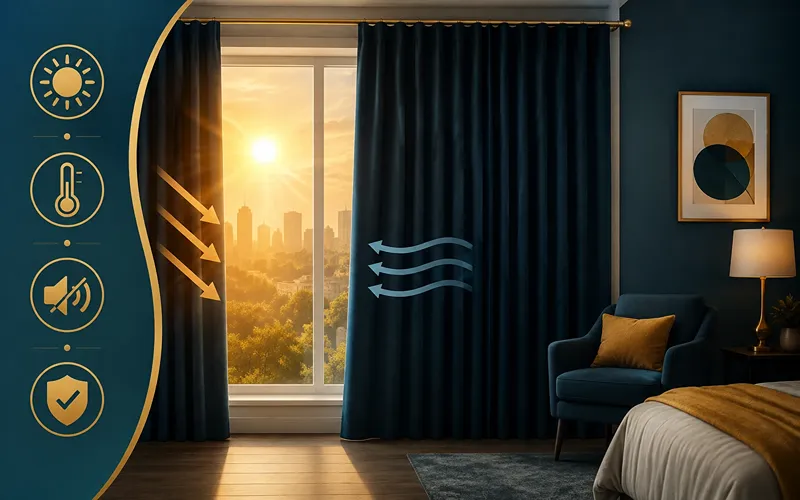
If your bedroom turns into an oven by four in the afternoon, you’ve probably already stood in a store aisle wondering whether a heavy curtain would fix it. The honest answer is yes, partly. A blackout panel will make that room cooler than bare glass would. It will not turn it into a walk-in fridge, and if you hang it badly, it can quietly make things worse.
This guide by Roller Blinds Dubai separates what the fabric actually does from what marketing copy promises, and shows you the handful of installation decisions that determine whether you feel any difference at all.
Do Blackout Curtains Keep Heat Out? The Short Answer
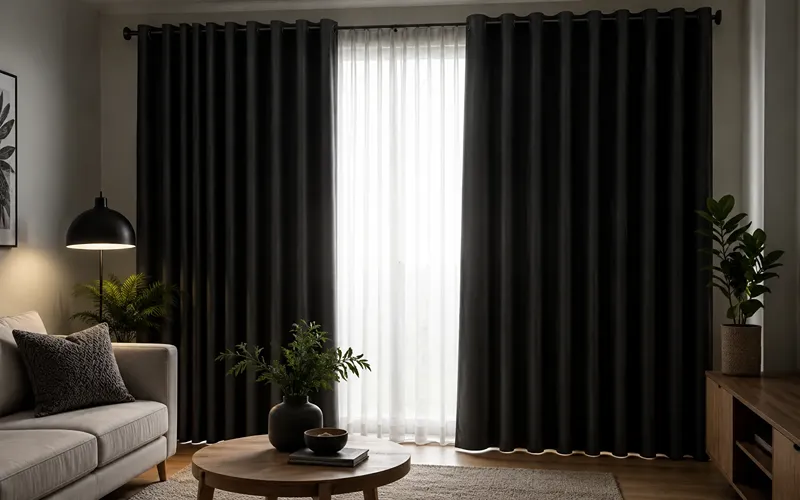
Blackout curtains reduce heat gain, but temperature control is their side job, not their main one. They were engineered to stop light. The density that blocks light also happens to slow heat, which is why they help, and why a thin, unlined blackout panel disappoints people who bought it expecting a temperature drop.
Three things decide how much cooling you actually feel:
- Whether the panel has a thermal or reflective backing
- What color faces the glass
- How completely the panel seals the window opening
Get all three right and you’re looking at a genuinely noticeable difference. Get the third one wrong and the first two barely matter.
How Heat Actually Enters Through a Window
Understanding this makes every recommendation below obvious rather than arbitrary.
Radiant heat (the big one)
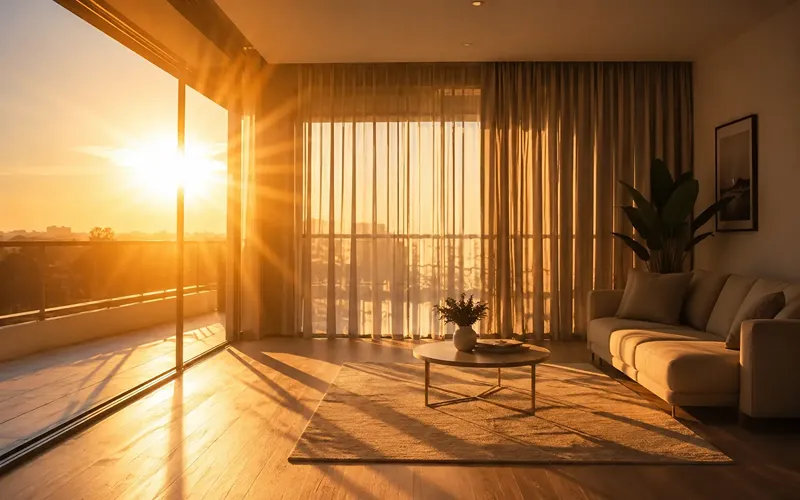
Sunlight passes straight through glass and lands on your floor, furniture, and walls. Those surfaces absorb the energy and release it as warmth. In summer this is the dominant source of unwanted indoor heat, not warm air sneaking in, but light converting into heat after it’s already inside.
This is exactly where curtains do their best work. Intercept the sunlight before it turns into heat, and you’ve stopped the problem at the source.
Conducted heat
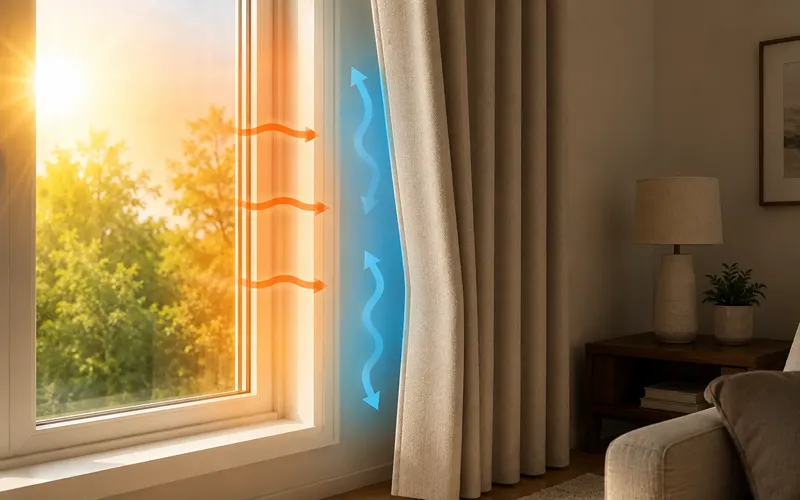
Glass warms up in direct sun and transfers that warmth into the air on your side of the window. Curtains slow this by holding a pocket of still air between fabric and glass. Still air is a poor conductor of heat, which is why that trapped layer does most of the insulating, not the fabric itself.
Air movement and leakage
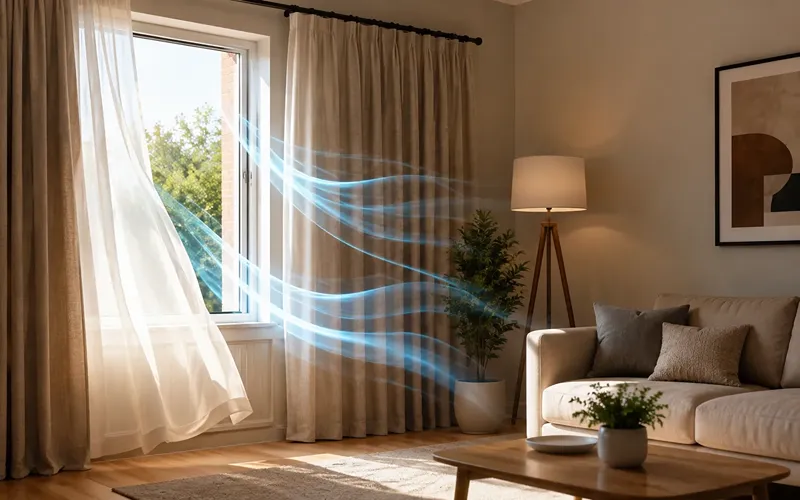
Older frames, single-pane windows, and worn seals let air pass through. A curtain can’t reseal a frame, but covering the opening more completely limits how freely air circulates past hot or cold glass.
What the Data Actually Says?
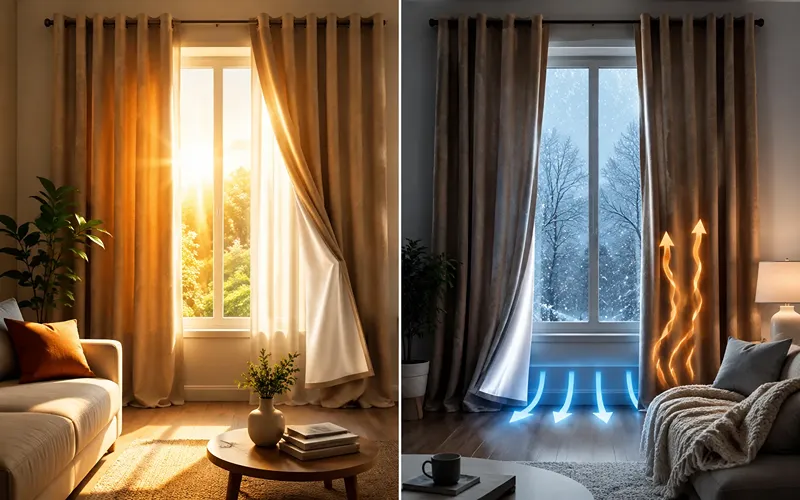
Medium-colored draperies with a white reflective backing can reduce summer heat gain by roughly a third when closed during the day. Curtains with thermal lining can cut winter heat loss by up to about a quarter.
Manufacturers often quote 40% or higher. Those numbers usually come from ideal-condition lab tests with perfect coverage and no gaps, useful as a ceiling, not as a promise for your living room. Treat a third as a realistic best case for a well-chosen, well-hung panel.
For context, tightly fitted cellular shades can block up to about 60% of solar heat, because their honeycomb cells trap air right at the glass. Curtains trade some of that raw efficiency for coverage, softness, privacy, and looks.
Blackout vs Thermal vs Insulated vs Lined: What Each Label Means
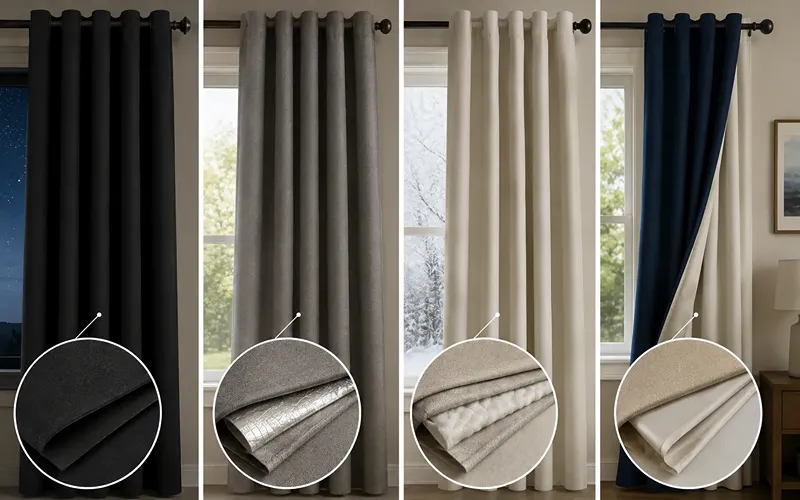
These terms get used loosely, and shoppers pay for the wrong one constantly.
| Label | Primary purpose | Effect on temperature | Best suited to |
| Blackout | Blocks light through the fabric via tight weave, coating, or a dedicated liner | Helps as a byproduct of density | Bedrooms, nurseries, media rooms, shift workers |
| Thermal | Slows heat transfer at the window | Direct and intentional, the whole point | Sunny or drafty rooms, older windows |
| Insulated | Emphasizes a denser multi-layer build | Similar to thermal, usually heavier | Extreme climates, large glass areas |
| Lined | A functional liner behind a decorative face fabric | Depends entirely on which liner you chose | Keeping a fabric you love while adding performance |
The practical takeaway: one panel can be several of these at once. A thermal blackout curtain is what you want if heat is the goal. A plain blackout curtain is what you want if sleep is the goal and cooling is a bonus.
What Blackout Curtains Are Genuinely Good At?
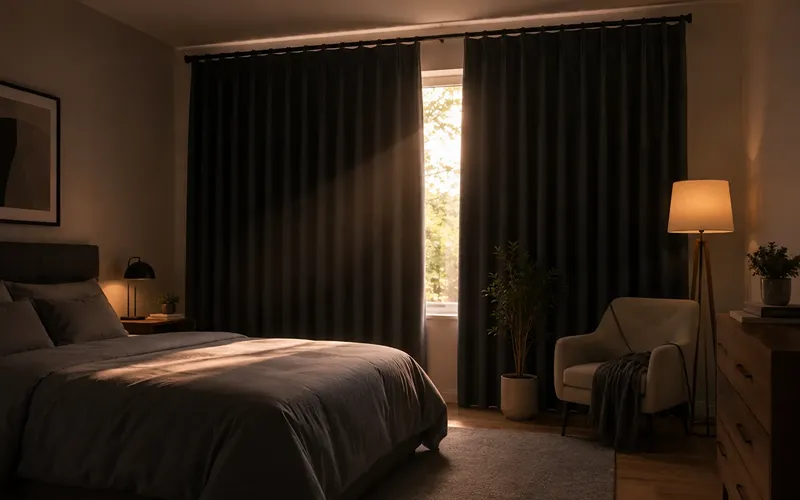
Temperature is only part of the return you get.
- Cooler afternoons on sun-facing windows. East-facing rooms bake in the morning, west-facing rooms suffer from mid-afternoon onward. These are where you’ll feel the biggest change.
- Lower cooling load. Less solar heat entering means your AC cycles less often. The savings won’t be dramatic, but they compound over a long hot season.
- Real darkness for sleep. Still the strongest argument for buying them, especially for night-shift workers, babies, and anyone light-sensitive.
- Furniture and floor protection. Blocking direct sun slows fading of wooden furniture, upholstery, artwork, and rugs.
- Noise softening. Dense multi-layer fabric absorbs sound and reduces echo. Noise-reducing, not soundproof, an important distinction.
- Privacy after dark. An opaque panel blocks sightlines when interior lights are on and outside is dark.
- A renter-friendly upgrade. No permits, no permanent modification, and they move with you.
The Limitations Worth Knowing Before You Buy
The dark-fabric problem
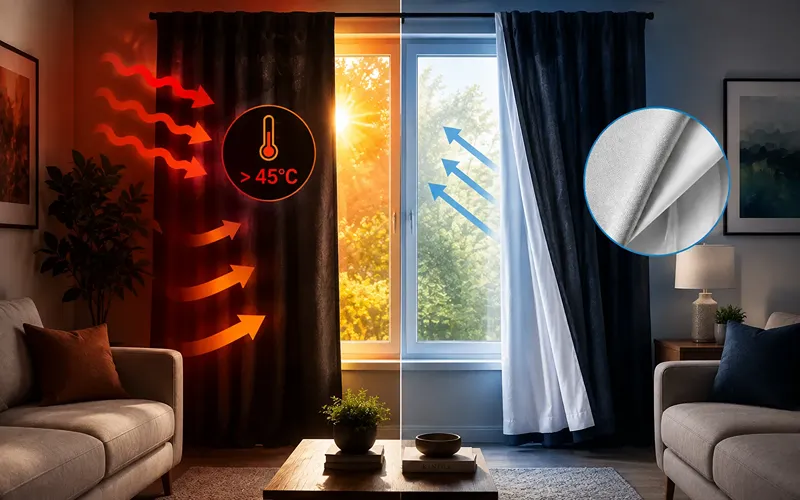
A heavy, dark, unlined panel absorbs sunlight rather than reflecting it. In direct sun that fabric can climb well past 45°C, and then it radiates the heat it collected straight into your room. You blocked the light and installed a low-grade radiator on your wall.
This is why the window-facing side matters more than the room-facing side. A white or light backing bounces solar energy back out through the glass before it becomes heat. Your decorative side can be charcoal, navy, or deep green, physics only cares about the surface pointing at the sun.
If you’re shopping ready-made panels, flip them over. Identical dark color on both sides means it wasn’t built with heat in mind.
The chimney effect
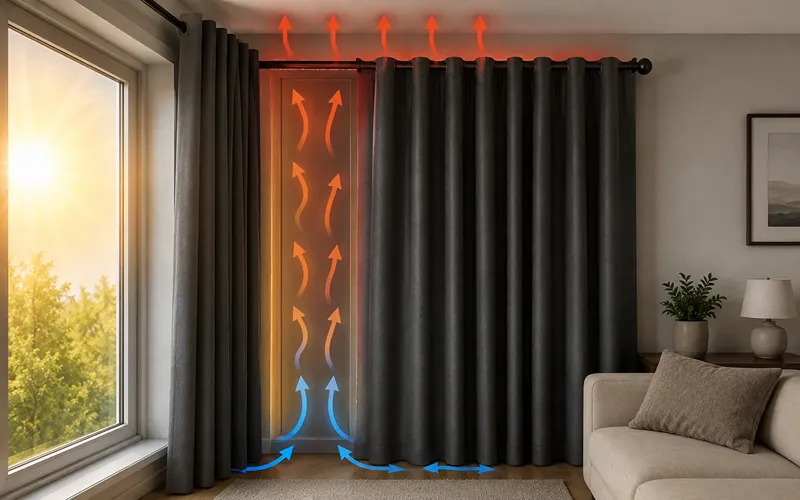
This is the mistake that quietly ruins otherwise good curtains. Sun heats the air trapped between glass and fabric. Hot air rises. If there’s an open gap above the rod, that heated air escapes upward into your room, and cooler floor-level air gets pulled up to replace it, heats against the glass, and repeats. You’ve built a convection loop that circulates warm air instead of holding it back.
The fix is sealing the perimeter, covered in the tips below.
They can’t fix the building
Curtains are a comfort layer, not insulation. They won’t compensate for an uninsulated roof, a failed window seal, or single-pane glass in a heat wave. If every room in the house runs hot regardless of orientation, the issue is the building envelope or the cooling system, and curtains will only take the edge off.
Expert Tips: Making Blackout Curtains Actually Block Heat
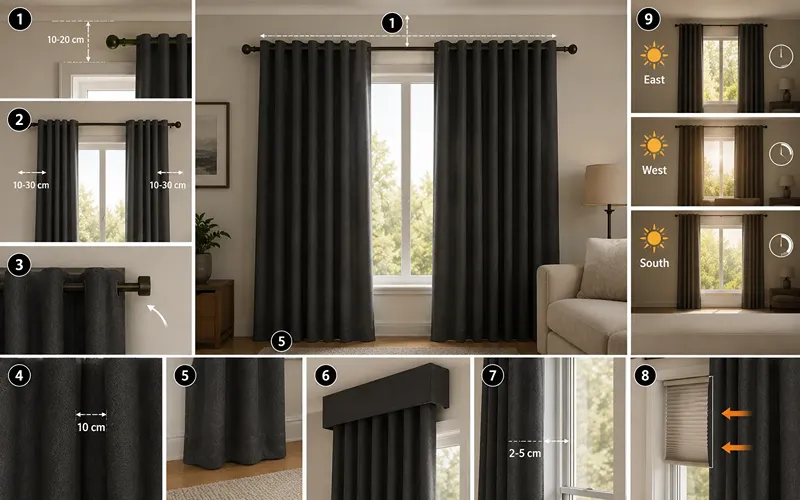
Fabric sets the ceiling on performance. Installation decides how much of that ceiling you reach.
- Mount high, not tight to the frame. Place the rod roughly 10-20 cm above the window frame. This lifts the top of the air pocket above the glass and reduces the top gap that feeds the chimney effect.
- Extend well past the sides. Run the rod 10-30 cm beyond the frame on each side so the fabric overlaps wall, not just glass. Outside mounting beats inside mounting for heat every time.
- Return the fabric to the wall. Use a bent or wrap-around rod so the panel edges touch the wall instead of hanging free. This single detail closes the side channel that most heat and light escape through.
- Overlap the center. With two panels, make sure they cross in the middle by at least 10 cm. A center gap is a direct line for both light and heat.
- Go floor-length. Panels should reach the floor or just brush it. A short panel leaves an open bottom edge that lets the convection loop complete itself.
- Add a cornice or pelmet if you can. A boxed valance across the top physically caps the air pocket. It’s the single biggest efficiency upgrade most people skip.
- Leave a small air gap at the glass. Two to five centimeters between fabric and window lets the still-air layer form properly. Pressed flat against the glass, the fabric just conducts heat instead of buffering it.
- Layer for serious heat. A cellular or roller shade inside the frame plus a blackout curtain over it gives you two barriers, one sealed at the glass, one sealing the perimeter. This combination outperforms either one alone by a wide margin.
- Work with the sun’s schedule. Close east-facing panels overnight and through the morning. Close west-facing ones by early afternoon. South-facing windows collect steadily through the day and benefit from being covered during peak hours.
How to Choose the Right Panel?
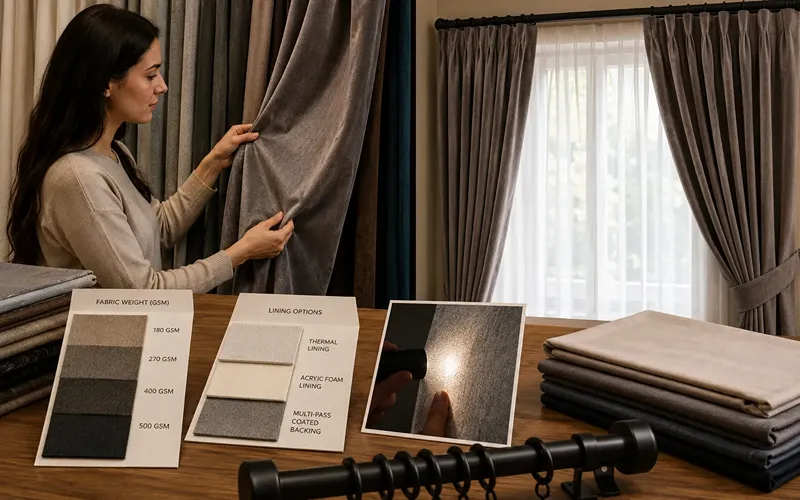
- Weight over label. Fabric density is usually listed in GSM. Around 270 GSM blocks light well; 400+ GSM adds real thermal mass and hangs with a better seal. Velvet is the classic dense choice.
- Confirm the lining. Look for thermal, acrylic foam, or multi-pass coated backing. “3-pass” and “4-pass” describe how many foam layers were applied, more passes, more insulation.
- Do the flashlight test. Hold the fabric against a bright light. Visible pinpricks mean the weave is open enough for heat to move through easily.
- Buy generously wide. Total panel width should be about 1.5 to 2 times the window width so the fabric still covers fully when gathered.
- Match hardware to weight. Heavy multi-layer panels need rated rods or tracks. Light clip rings will sag or fail.
Room-by-Room Quick Guide
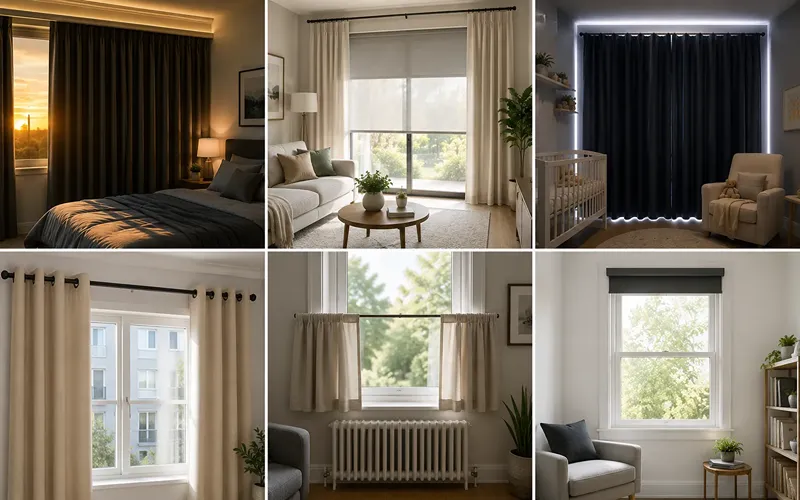
| Situation | What to prioritize |
| West-facing bedroom | Heaviest thermal blackout, light backing, cornice, closed by early afternoon |
| Living room with large glass | Layered roller or cellular shade plus light-colored thermal curtain |
| Nursery | Thermal blackout with full perimeter seal for darkness and steady temperature |
| Rented apartment | Tension rod or no-drill bracket, extra-wide outside-mount panel |
| Window with a heater below | Sill-length panels only, never let fabric sit over a heat source |
| North-facing room | Light control matters more than heat; a standard blackout is enough |
Common Mistakes People Make
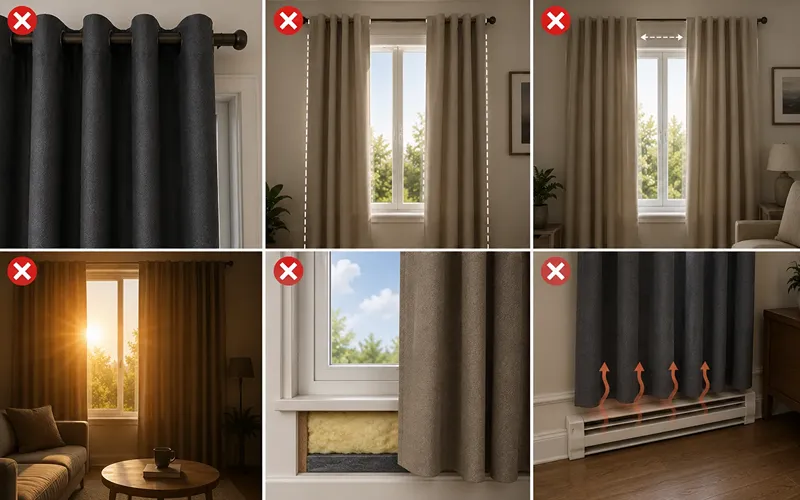
- Buying dark on both sides and expecting a temperature drop
- Mounting the rod exactly to the frame edge, leaving open sides
- Choosing panels too narrow to overlap when closed
- Leaving curtains closed after the room has already heated
- Treating curtains as a replacement for insulation or better glazing
- Hanging floor-length fabric over a radiator or baseboard heater
The Bottom Line
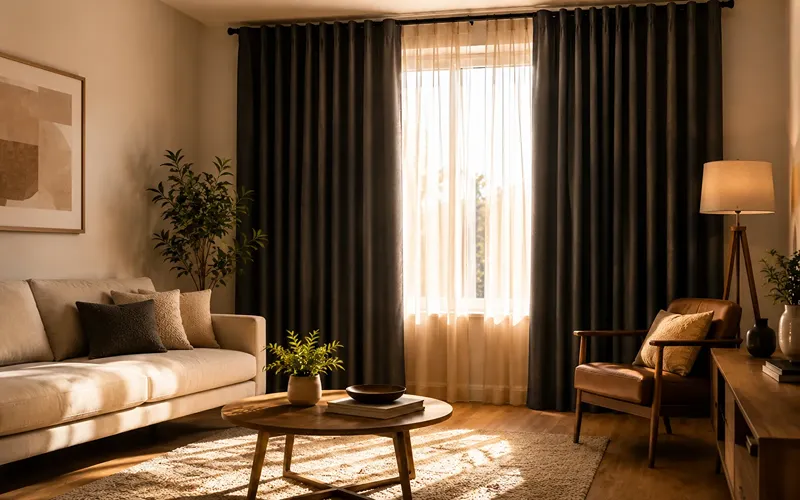
Blackout curtains do keep heat out, as a comfort layer, not a cure. The fabric determines how much performance is available; coverage and fit determine how much of it you actually receive. Choose a dense panel with a light reflective backing, mount it high and wide with the edges returning to the wall and the center overlapping, and close it before the sun arrives.
Do that on your two or three worst windows and you’ll feel the difference by afternoon. Skip the installation details and you’ll have a very dark room that’s still uncomfortably warm.
Frequently Asked Questions
Do blackout curtains keep heat out in summer?
Yes, meaningfully, roughly a third of heat gain in the best realistic case. The result depends on a reflective backing, full window coverage, and closing them before the sun hits.
Are blackout curtains the same as thermal curtains?
No. Blackout describes light blocking; thermal describes heat resistance. Many panels do both, but plenty of blackout curtains have no insulating lining at all. Check the backing before assuming.
What color blackout curtain is best for heat?
Whatever you like on the room side, as long as the window side is white, cream, or reflective. The outward-facing surface is what determines reflection.
Do blackout curtains help in winter too?
Yes. They slow heat escaping toward cold glass and reduce the draft you feel near windows. Open them during sunny hours to collect free warmth, close them at dusk to hold it in.
Do they lower electricity bills?
Indirectly. Reduced heat gain means less AC runtime. Expect a modest, cumulative saving rather than a dramatic drop, and more of it on sun-exposed windows than shaded ones.
Are cellular shades better than blackout curtains?
For pure insulation per square inch, yes. For darkness, sound absorption, perimeter coverage, and appearance, curtains win. The strongest setup uses both together.
Do blackout curtains work on single-pane windows?
They help more there than anywhere, because the baseline is so poor. They still can’t match what proper double glazing would deliver.
Should blackout curtains touch the floor?
Yes, unless a radiator, vent, or heater sits below the window, then choose a length that stops safely above it.
Do they work if left open?
No. An open panel is decoration. The still-air pocket only exists when the window is covered.